
How to Teach Climate Change:
A Practitioner Manual for
Climate Education
A whole-school framework for embedding climate and sustainability education in safe, practical and developmentally appropriate ways.
Complete with 128 outdoor practices for KS1 - KS4, designed to be starting points and adaptable for your setting.
This Manual and 8 Domains offers practical climate change teaching resources for teachers who want to help children understand climate issues through care, connection, and real-world action.
Buy as an Individual
Buy for up to 10 Staff
Buy for up to 20 Staff
Climate Education Without Fear
Developed by Marina Robb, founder of The Outdoor Teacher, this practitioner manual draws on over 30 years’ experience in outdoor learning, child development, wellbeing and systems-based education.
A survey of 1,000 children in the UK found that 50% reported either feeling extremely worried or very worried about climate change and 28% reported this impacted their daily lives and functioning' (Hickman C et al 2021)
It has been written in response to the growing expectation for schools to address climate education - and the very real concern about how to do this well without creating fear, overload or unrealistic demands on staff.
This manual offers a clear, grounded framework that supports confidence, coherence and care.
Why this manual matters now
The Department for Education’s Sustainability and Climate Change Strategy (2023) sets the ambition that by 2025:
Schools are expected to:
Appoint a Sustainability Lead
Have an active Climate Action Plan (CAP)
Plans are expected to address:
Decarbonisation & Net Zero
Adaption & Resilience
Biodiversity & Nature
Climate Education & Green Skills
While guidance was initially non-statutory, this is now a clear system expectation, increasingly linked to inspection, funding and accountability.
The risk for many schools is that climate education becomes:
Another Compliance Task
Another Burden on Already Stretched Staff
This manual offers a different way in.
This manual is:
A whole-school practitioner manual for climate education
Designed for real school life, not ideal conditions.
Grounded in:
Outdoor Learning, regulation and wellbeing, nature connection and scientific and systems understanding.
This is not a scheme of work or qualification.
While the manual does not provide step-by-step lesson plans, it offers clear guidance, principles and practical structures that schools can integrate into their existing curriculum planning.
It is a shared framework that helps schools respond in ways that are thoughtful, credible and emotionally safe.
Who is this manual for?
This manual is for schools and educational settings as a whole.
It is intended to be used collaboratively by teachers, teaching assistants and practitioners working directly with children and young people; sustainability, wellbeing and inclusion leads coordinating this work; and headteachers, managers and senior leaders responsible for ensuring the school has a clear and credible response.
The manual is designed to be shared across staff, forming a common reference point rather than sitting with one role or department.

"I love the background information that it provides and the way it can be used across the curriculum in a more integrated way, rather than another separate, stand-alone subject. It is a brilliant, straightforward and comprehensible manual for busy teachers and schools, that don't have time or space to fit another subject into their timetable."
"Marina has produced a comprehensive teachers manual, on the wider aspects of climate change and how to adapt eight domains of this complex subject, into a guide for busy teachers.
It combines clear factual information as a starting point, as well as initial ideas to develop with children from key stage one to four. These ideas have clear progression, over the different subject areas and will help children appreciate the changes in their world and the part they can play in helping to preserve it for future generations.
A very important paper to inform teachers of this essential and important subject area."
"A very educator-friendly and practical guide into the historical, economic, political and cultural contexts that have led to our current climate crisis. It outlines clearly and with accessible examples, the ways in which we can work with our learners to help them to engage differently with themselves, each other and the world, so that we can collectively take responsibility for a healthier future."
"The activities in each domain come across as simple but with a lot of depth, where a great deal of learning can be drawn out. Most importantly, as a time poor teacher, I could use these to quickly put together a solid lesson plan. I liked the focus on teaching children critical thinking and giving them the tools to reflect, question and discern information for themselves."
What's Included?
The Manual
The Climate Education Practitioner Manual PDF includes:
- Clear background guidance for adults (Part 1 - 4)
- Practical, ready-to-use outdoor practices (128 Suggested Practices across KS1 - KS4)
- Climate Action Plan Grid and curriculum links
- Guidance that supports regulation, agency and emotional safety
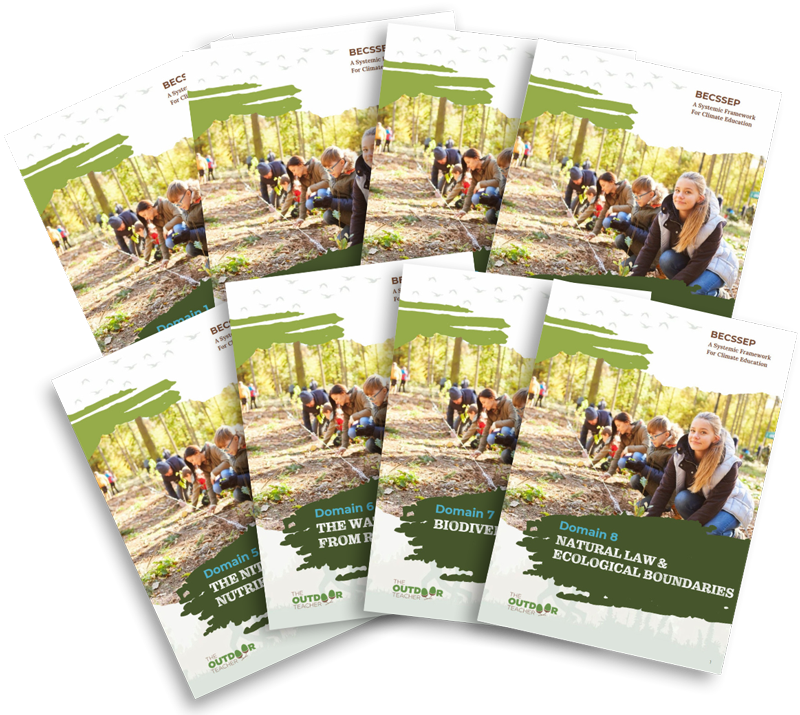
It includes eight climate domains, each focusing on a key aspect of climate education that schools need to consider. The domains provide age-appropriate, context-sensitive ideas and practices that can be applied flexibly across different phases, themes and settings.
The domains are designed to be explored one at a time, in ways that fit each school’s context, priorities and capacity.
The Eight Climate Domains
The domains focus on the human capacities young people need to live well in a changing world:
- New Vision: Fair Share, Power & Justice
- Ecological Citizens: Human Health & Wellbeing
- Democracy and Agency
- Carbon Cycle & Real Zero
- Nitrogen & Nutrient Cycles
- Water Cycle: Rivers to Oceans
- Biodiversity
- Natural Law & Ecological Boundaries.
How this supports your school or setting
For teachers and practitioners, the manual builds confidence in addressing climate-related topics through outdoor learning. It offers practical guidance that can be adapted across ages, needs and contexts, supporting emotionally safe, thoughtful practice without adding pressure or workload.
For leaders and managers, the manual provides a coherent framework staff can work from together, offers a credible way to evidence climate education within a Climate Action Plan, and supports clear alignment with wellbeing, inclusion and curriculum priorities. This enables a consistent, whole-setting response that is developmentally appropriate and grounded in care.
How to use it
- You do not need specialist knowledge
- You do not need to “cover” everything
- Small, consistent practices matter more than perfect plans
The depth of this research-informed framework reflects the urgency of the climate crisis, while its structure allows busy teachers to draw from it practically and selectively.
Format & Pricing
The Climate Education Manual is delivered as a PDF and is designed for whole-school use.
Single Licence
Buy for up to 10 Staff
Buy for up to 20 Staff
Personalised approach
If your school, trust or organisation is looking for a more personalised approach, there may be opportunities to explore additional support or guidance with Marina and The Outdoor Teacher team.
Please contact us to discuss what might be helpful for your setting.
FAQ
DfE expects schools to appoint a Sustainability Lead to coordinate Climate Action Plans
This works best when a sustainability, wellbeing, or inclusion lead coordinates day-to-day activity
Senior leaders provide strategic backing and direction
Practitioners embed it through everyday teaching and outdoor practice
The manual doesn’t require specialist climate knowledge
It offers a shared framework for staff, reducing reliance on individual champions
The aim is to make climate education part of normal practice across the setting
The Eight Climate Domains are designed to be worked with gradually and flexibly, in ways that fit each setting’s capacity and priorities.
Most schools begin with:
- One domain
- One regular practice over a half-term or term
Domains can be revisited and deepened over time, supporting progression without the need to “cover” everything.
This approach aligns well with Climate Action Plans, which are expected to be living documents that develop over time rather than one-off submissions.
Progress is built through:
- Repetition
- Shared language
- Consistent, relational practice
This manual is intentionally written at a high academic level to ensure teachers and leaders are working with accurate, up-to-date science and sound systems understanding. Climate education carries real weight, and it is important that adults are supported with rigour rather than oversimplification.
You are not expected to read it cover to cover. The framework is designed so staff can dip into relevant sections over time, drawing on it as a reference point rather than a checklist.
Its purpose is to help adults translate complex ideas into developmentally appropriate, emotionally safe learning for children and young people.
Yes, Marina Robb is an author and UK Forest School Association Endorsed Trainer and has been training Forest School Leaders since 2011. She has been working with groups in nature since 1995 and you can read more here.
Yes. The framework is intentionally age-appropriate rather than age-specific and is designed to work across the full education system, including Key Stage 1 - 4 - primary, secondary and appropriate alternative provision.
The same domains can be explored through:
Sensory, play-based and relational practices in early years
Inquiry, systems thinking and responsibility in primary
Deeper agency, ethics and real-world application in secondary
Practitioners are encouraged to use their professional judgement when adapting activities.
The Department for Education expects schools to appoint a Sustainability Lead to coordinate Climate Action Plans and related activity.
In practice, this work is most effective when:
A sustainability, wellbeing or inclusion lead coordinates the approach
Senior leaders support it strategically
Practitioners bring it to life through everyday teaching and outdoor practice
The manual is designed so that leadership does not require specialist climate expertise. Instead, it supports the Sustainability Lead and leadership team by providing a shared framework staff can work from together, reducing reliance on individual champions and helping climate education become part of how the setting operates.
Yes. While the manual references current UK government expectations around Climate Action Plans and sustainability leadership, the framework itself is not UK-specific.
The Eight Climate Domains, Outdoor Teacher approach, and emphasis on systems thinking, wellbeing and agency reflect widely recognised best practice in climate and sustainability education.
Schools outside the UK can use the framework in ways that align with their own national, regional or organisational requirements.
The practices are written with flexibility in mind and are designed to be adapted for different developmental stages and needs. While this manual is not a specialist SEND guide, many of the approaches - including outdoor learning, sensory engagement, relational practice and small-group structures - align well with inclusive and trauma-aware education.
We recognise that educators may need to make thoughtful adaptations for learners with visual impairments, mobility needs, neurodivergence, or other specific requirements. Further guidance focused specifically on adaptation and accessibility is being developed, and we welcome dialogue from practitioners in this area.
The Outdoor Teacher, alongside its sister organization Circle of Life Rediscovery CIC aim to transform health, education and family through nature.
We are whole-heartedly concerned about the safeguarding of future generations, human and non-human alike, and the growing understanding of reciprocity between humans and nature. Whilst we are advocates for all people accessing nature and its benefits, we know that this is only healthy if we prioritise the care for the natural world and address issues of equality.
The Outdoor Teacher is working towards becoming a certified B-Corp. Certified B Corps are a new kind of business that balances purpose and profit. They are legally required to consider the impact of their decisions on their workers, customers, suppliers, community, and the environment. We aim to be part of this community of leaders, driving a global movement of people using businesses as a force for good.
We are using Monzo Business Banking which is listed as an ethical bank: https://monzo.com/ethics.